Ours began with one case.
That case revealed how easily fairness can disappear. It showed how the system gives wrongdoers a path to avoid accountability while silencing those who speak up.

That case revealed how easily fairness can disappear. It showed how the system gives wrongdoers a path to avoid accountability while silencing those who speak up.



When Dan raised concerns about a device defect that caused avoidable patient injury, he expected the truth to matter.
Instead, his employer responded with lawyers, forced arbitration, and the silencing mechanisms of confidentiality and non-disclosure agreements. Fairness disappeared behind rules and procedures in a private forum the company chose, paid for, and required as a condition of employment.
After prevailing in arbitration through false testimony about a known device defect capable of causing “very serious and life-threatening” injury, the company converted the private award into a public judgment in a federal court that acknowledged it lacked the power or discretion to review the facts.
That sequence sparked Equal Fight Advocates.
These two positions, taken before different federal authorities, cannot both be true.
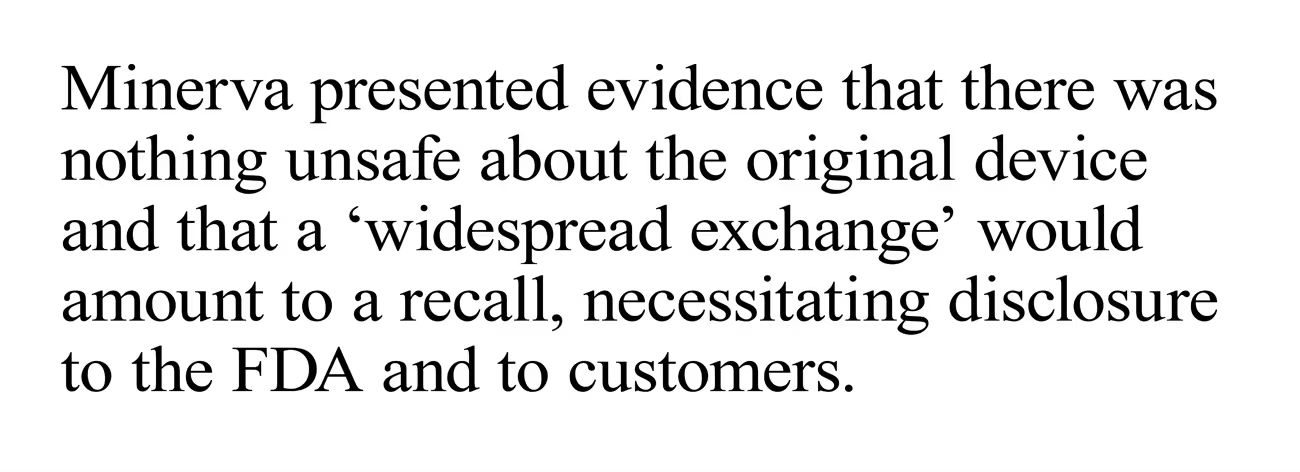
To convert a private arbitration award against a whistleblower into a federal judgment:
There was “nothing unsafe” about the device.
To secure a patent correcting a defect in that same device:
The device was capable of causing “very serious and life threatening” injury.
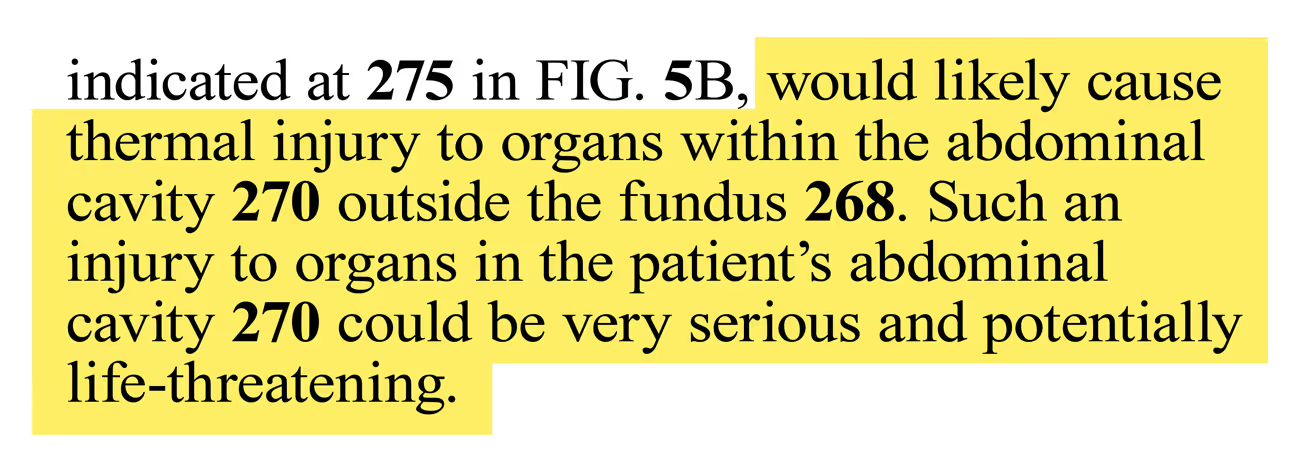

A device cannot be both completely safe and dangerously defective. One representation is true. The other is not.
The company’s representation to the U.S. Patent Office that its device contained a defect capable of causing “very serious and life-threatening” injury was consistent with its regulatory filings, internal testing, company documents, and policies.
After the district court sustained a Statement of Evidence reflecting that the company believed its patent representations were true, the company changed its position on appeal and conceded that the device had a known defect that caused patient injuries.
The statement that there was “nothing unsafe” about the device appears only once: in forced arbitration, in a private forum the company required and paid for as a condition of employment.
The process by which known falsehoods or wrongful conduct become legitimate once laundered through private arbitration and confirmed by a court powerless to review the arbitrator’s award. By the time it’s enforced, the fraud is clean—and the truth no longer matters.
From Forced Arbitration to Federal and State Courts
Peterson v. Minerva Surgical, Inc., et al.
In response to the motion to vacate the award, Defendants argued that “determining whether the medical device was flawed is not the role of this Court” and that “the existence of contrary evidence … is not grounds for vacating an arbitration award.”
The district court agreed, denied the motion to vacate, and confirmed the award under the Federal Arbitration Act.
Peterson appealed to the Tenth Circuit.
On appeal, after the record was supplemented with Minerva’s sworn declaration to the U.S. Patent Office, Defendants conceded:
• Minerva worked on product improvements in response to reports of injuries caused by limitations in the product design.
• The original device had a known defect that injured patients.
• Peterson advocated for patient safety based on comparative incidents of injury.
Despite those statements, the Tenth Circuit affirmed:
“We do not have discretion.”
“Federal courts do not have power.”
“We have no power.”
Peterson v. Minerva Surgical, Inc.,
No. 24-3003 (10th Cir. Aug. 15, 2024).
In affirming the district court, the Tenth Circuit confirmed that federal courts lack authority to review the factual findings of an arbitration award. A private decision can thus become a public judgment without judicial review of its factual basis.

Although the U.S. Supreme Court denied the petition, the case raised significant questions about forced arbitration and judicial review.
The petition addressed a longstanding tension. When Congress enacted the Federal Arbitration Act in 1925, it established arbitration as an alternative to litigation—not a substitute for judicial oversight. Courts at the time were cautious of arbitration because it risked bypassing essential judicial review and compromising justice.
A century later, modern jurisprudence has evolved to prioritize finality over fairness. At the same time, courts acknowledge that they lack power or discretion to review the underlying facts, even as they use their constitutional authority to convert private arbitration awards into enforceable public judgments.
The petition presented three questions:
The Court denied the petition.
The case drew national attention, including an amicus brief from Lift Our Voices (liftourvoices.org), an organization dedicated to transforming the American workplace into a safer and more equitable environment and to raising awareness about the harmful impacts of forced arbitration and nondisclosure agreements.
Founded by journalist Gretchen Carlson and political consultant Julie Roginsky, Lift Our Voices submitted its brief on behalf of workers and the public, stating:
“This case highlights the urgent need to address the misuse of forced arbitration and NDAs as silencing mechanisms that undermine healthy workplaces, obstruct justice, and shield corporations from accountability and public scrutiny. Granting certiorari offers the Court an opportunity to examine a century of evolving judicial doctrine that has created court conflict, enabled misconduct, and eroded the principles of fairness and justice essential to an equitable legal system.”
On the day the U.S. Supreme Court considered the petition in conference, Tom Devine, Legal Director of the Government Accountability Project (whistleblower.org), issued a statement addressing the structural risks of forced arbitration for whistleblowers.
Devine warned that when arbitration is controlled by the defendant, “the normal defendant would control the outcome.” He explained:
“If mandatory arbitrations controlled by an employer are the channel to enforce rights, those rights are merely a time-consuming, recourse-draining honor system. Under this structure, the employee’s only right is asking an employer to change its institutional mind.”

Equal Fight Advocates exists because one person refused to accept silence as procedure—and another chose to give that refusal form.
This is not only a legal story. It is the decision to organize experience instead of letting it disappear.
If you are here, you are already looking beyond the surface.
Continue...

Structure and design
by Mihai Bratoi
Our mission is simple.
Legal services are provided through DE Peterson Law, LLC.
© DE Peterson Law, LLC | All rights reserved.